Author’s Note
This article was first published in September 2020 following graduation from GSD. It is republished here with minor edits to preserve its original authenticity, with an added 2026 postscript capturing where this path has led six years later.
Who you are today is the result of all the decisions you have made in the past. Similar to the domino effect, one event paves the way for the next one. Metaphorically, life consists of the connectedness of links that ultimately form solid chains in different areas.
For a chain formation, the first link is needed to hold its successive ones. It is quite intriguing to fully comprehend the strength of a metal chain composed of simple interconnectedness.
Nonetheless, there was a period of life in which I was not aware of such a principle. Consequently, in my constant strives to grow in my professional career, I felt frequent frustration. Whenever I look back at all events that have brought me to where I am today, I become more convinced that life is a chain of events. Although all areas in life have particular relevance, I dedicate this writing piece to the chain of self-realisation.
One thing leads to the other.
Many events trigger major turning points, switching the direction of life. This was particularly evident when I moved to Geneva after six years of dreaming about conducting my master’s studies abroad, ever since I graduated from my Bachelor’s degree programme in Bolivia.
I had ultimately given up on that dream due to the financial implications of studying abroad. But I had decided to move to Geneva from my home country anyway, without a clear or specific purpose. My main goal was to find new opportunities to keep growing professionally.
During the first months of getting used to life in Switzerland, I felt an intuitive need to prepare for something that would change my life. I welcomed that transition phase into the unknown, and I joined intensive French lessons before finding a traineeship in the human rights field at a civil society organisation based in Geneva, whose work revolves around the UN Human Rights Council mechanism.
During the time I worked there, besides gaining knowledge and expertise on issues that were of my particular interest, I met very interesting colleagues. One of the trainees working there came from the Kingdom of Jordan. When chatting with her, I learned she was a student at a local private university. I had never heard of that university before.
After some weeks, she left her traineeship post at the organisation. Right after she left, the Executive Director transferred me to the computer that was previously assigned to her. Navigating on that computer, I found that her Facebook profile was visible. Before even starting to focus on my own business, something called my attention on her online profile. She had marked her master’s degree education programme with the name of her university: the Geneva School of Diplomacy and International Relations.
Having worked in advertising departments for universities in the past, I found that name very attractive from a marketing perspective. After a sequence of clicks on that computer, I was redirected to the university’s website, a very enticing one. Suddenly, I was once again lured by the idea of conducting my master’s studies in an international programme.
The sequence of links continued, leading me to set an appointment with the admissions officer, a very nice lady from the Philippines. It turned out that the university had an Executive Master’s programme that, although still requiring a significant investment, I found more affordable than other programmes and highly practical for someone who was working during the week.
I applied for financial aid in exchange for working hours at the university, which I still see as a very pleasurable experience. I resorted to a student loan. I sent my application, eventually received the acceptance letter, et voilà. There I was, already enrolled in the 2017 intake of the EMIR programme: Executive Master in International Relations.
Finally getting enrolled
At that particular moment, the sole fact of finally being enrolled in such a master’s programme was enough to feel completely satisfied. By then, I had gone through tens of applications to several different scholarships, with the aim of studying my master’s degree in the UK, the US, Australia, New Zealand, and Spain.
I had gone through several rejections for full, all-encompassing scholarships, and even got to feel like there was a type of imaginary stonewall hampering my dreams of conducting my master’s degree in an international programme. But the stonewall started to vanish when I found the opportunity to study in the most diplomatic neighbourhood: Geneva.
For some of my classmates in the EMIR programme, being enrolled and studying in Geneva was seemingly not such a big deal as it was for me. Some of my classmates were very high-ranking diplomats and representatives of their respective governments: an Ambassador and a Parliamentarian from Afghanistan, an Ambassador from Moldova, a Counsellor from Costa Rica, and so on.
I was sharing the class with those high-ranking people but had the aegis of no government at all. What I did have, however, was a backpack filled with gratitude, a pending student loan, and my willingness to learn and make the most of my master’s programme.
As a matter of fact, I did. I dedicated more hours to my studies than to any other activity during the duration of my programme. After finishing my human rights traineeship, I spent most of my days at the library of the United Nations Office in Geneva, researching, writing scholarly papers, planning my thesis, and reading class materials.
I did not miss any of my classes and even memorised all academic guidelines for writing academic pieces. I fully absorbed my academic programme and took the greatest possible advantage for a whole year.
A couple of months later, thanks to the network I established during my dissertation research process, I was lucky enough to land my first formal job in international relations in the city of Geneva, at a Permanent Mission to the United Nations, where I had the privilege to serve for around two years.
Graduation Day
I still find it difficult to explain how happy I felt during my graduation day in the summer of 2018. Graduation day symbolised the opportunity of having shared a classroom with a multicultural and diverse group of interesting diplomats, but most importantly, amazing individuals.
It symbolised the opportunity of having acquired knowledge about the work of international organisations in Geneva. It symbolised an accomplishment as such, and for me, it symbolised a major overcoming of obstacles, the demolition of my imaginary stonewall.
With the culmination of my EMIR programme, a new interconnecting link was added to my chain of self-realisation.
Lesson learned
I am aware that I will probably continue to stumble upon similar experiences and hence with new stonewalls before achieving new goals. Fortunately, I realised that even if new obstacles emerge, it is possible to turn difficulties into opportunities to continue growing.
Accordingly, should my path bump into stonewalls again, my EMIR experience shall remind me that no limitation will be significant enough to prevent me from continuing with the building of my personal chain of accomplished dreams and self-realisation.
13 September 2020, Geneva.
Postscript, 2026 Update: The Chain Continues
Looking back six years after writing this piece, I am grateful to see how that landmark chapter in Geneva served as the main foundation for the links that followed.
Since graduating from the EMIR programme, the journey has taken me from Geneva’s international arena back to my home country, Bolivia, and across global advocacy platforms. Today, as a communications and gender mainstreaming professional in international development, I continue to leverage the policy strategies, human rights approaches, and global perspectives I cultivated during my time at the Geneva School of Diplomacy.
Every day at work, whether I am leading the on-the-ground implementation of public health programmes or advocating for gender equality on the global stage, my EMIR experience continues to remind me that we can overcome any obstacle with determination, patience, and resilience.
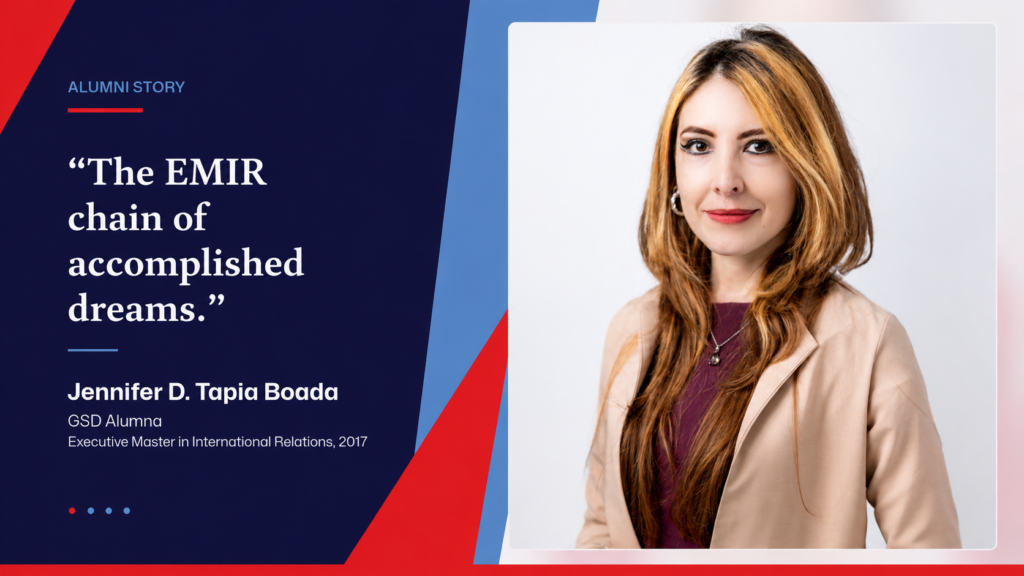
Jennifer Tapia Boada is an external communications, gender mainstreaming, and international development professional with over 15 years of experience advancing human rights and global health equity.