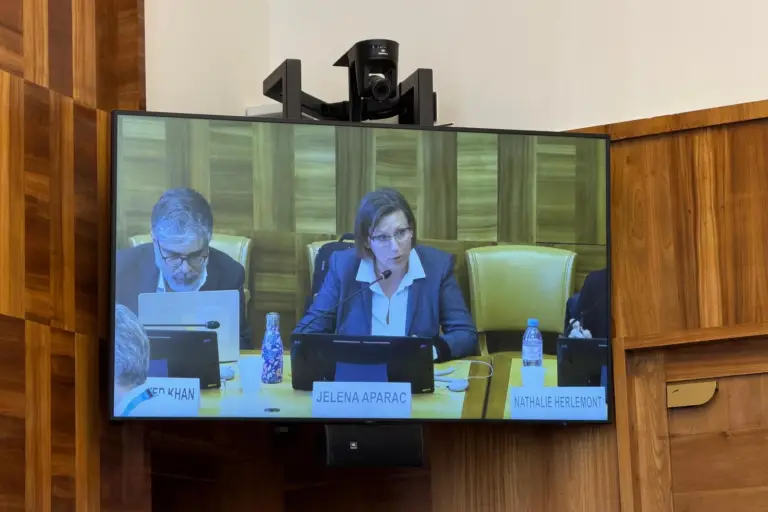
Dr Jelena Aparac, Senior Academic Programme Coordinator and Professor of International Law at the Geneva School of Diplomacy, contributed to the London Conference on International Law 2026, held at the QEII Centre in Westminster on 1–2 October.
The biennial conference brought together legal practitioners, judges, academics, policymakers and representatives of international institutions to consider the challenges confronting the international legal order.
Dr Aparac participated in the panel “Non-State Actors and International Law: Accounting for Plural Power,” which examined how international law is responding to a world in which States no longer exercise power alone.
International Law in a Multi-Actor World
Corporations, armed groups, non-governmental organisations, Indigenous communities and other non-State actors increasingly shape security, humanitarian action, technological development, climate governance and the global economy.
While States remain central to the international legal system, these actors can exercise considerable coercive, economic, technological and informational power.
The panel therefore considered a fundamental question: how should international law respond when the actors influencing international affairs do not fit neatly within traditional State-centred legal frameworks?
Dr Aparac focused particularly on private military and security companies (PMSCs) and their expanding role across conflict and non-conflict settings.
PMSCs now operate in areas including maritime security, extractive industries, migration management, border control and detention. In armed conflicts, their activities may also contribute to the prolongation of hostilities and aggravate the risk of human rights and international humanitarian law violations.
Responsibility Must Follow Power
A central theme of Dr Aparac’s contribution was that outsourcing security functions cannot be allowed to weaken responsibility.
PMSCs may operate on behalf of States, corporations, armed groups or other private actors. Their involvement can produce complex chains of authority in which several public and private entities participate in, benefit from or influence the same operation.
These arrangements can make it difficult to establish who bears responsibility when violations occur.
As Dr Aparac emphasised, “Outsourcing cannot mean dilution of responsibility.”
International legal and accountability mechanisms must be capable of following the exercise of power, including in situations where several private actors operate together or where the relationship between a company and its contracting authority is deliberately obscured.
Strengthening Monitoring and Accountability
Reflecting on the discussion, Dr Aparac identified three areas requiring further attention.
First, international institutions need stronger specialist expertise to monitor the activities of mercenaries and private military and security companies, document their impact and provide reliable information for policymaking.
Second, international monitoring and reporting mechanisms must ensure that the conduct of these actors is properly captured when documenting violations of international human rights law and international humanitarian law.
Third, domestic and international accountability mechanisms must be strengthened so that victims can access effective remedies, even when responsibility is distributed across several organisations, jurisdictions or contractual relationships.
Together, these measures would help ensure that legal responsibility reflects the realities of how power is exercised in contemporary conflicts and security operations.
Wider Challenges for the International Legal Order
The conference also explored a broader range of questions at the intersection of law, technology and global governance.
Discussions considered whether artificial intelligence could or should play a role in adjudication, whether parties should be permitted to agree to the use of AI in legal decision-making, and how accountability should operate when automated systems contribute to legal outcomes.
Other sessions addressed environmental crimes, sanctions against the International Criminal Court, the global rule of law and the resilience of international institutions.
These discussions reflected the central concern of the conference: whether existing international legal principles and institutions remain capable of responding to rapidly changing structures of power.
Dr Aparac’s contribution demonstrates the importance of connecting academic legal analysis with the practical challenges faced by international institutions, affected communities and those seeking accountability.
Her participation also reflects the Geneva School of Diplomacy’s continued engagement with contemporary debates in international law, international security, human rights and global governance.