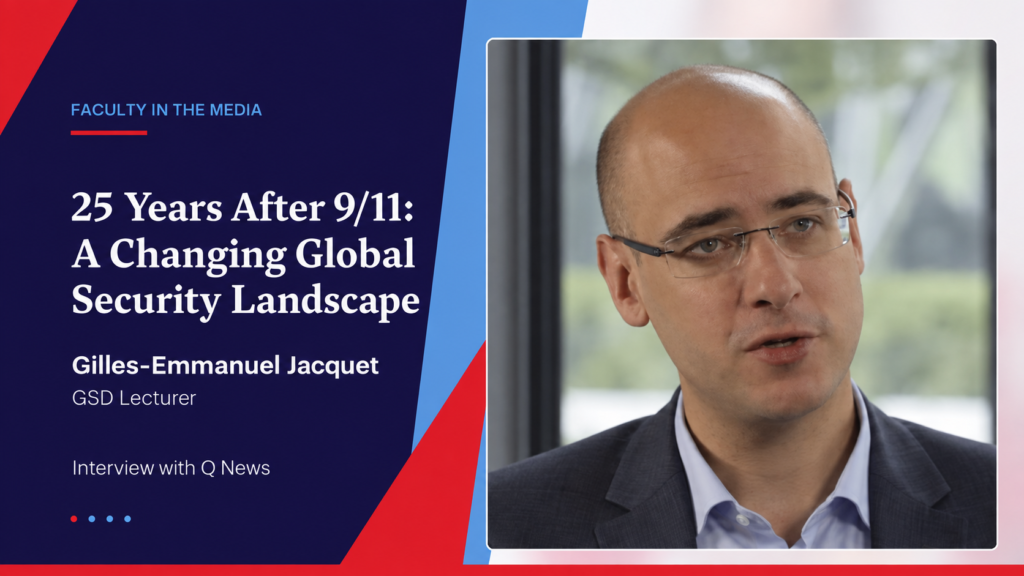
GSD faculty member Gilles-Emmanuel Jacquet joined Q News to examine the lessons of the post-9/11 era and the new threats reshaping international security.
Twenty-five years after the attacks of 11 September 2001, the international security landscape has changed considerably. Terrorism remains a concern, but it now exists alongside renewed great-power competition, interstate warfare, cyber threats, emerging technologies and an increasingly fragmented international order.
Gilles-Emmanuel Jacquet, lecturer at the Geneva School of Diplomacy and Vice-President of the Geneva International Peace Research Institute, recently joined the Q News programme Think Tank to discuss this evolving environment.
Joining the programme from Geneva, Jacquet took part in a discussion moderated by Hala El-Hamalawy. He appeared alongside Peter Roff, contributing editor at Newsweek, who joined from Washington.
From the War on Terror to Geopolitical Competition
During the interview, Jacquet described 9/11 as a turning point between the predominantly unipolar international order of the 1990s and the more complex global environment that followed.
The attacks brought terrorism to the centre of international security policy and prompted major military interventions, expanded counterterrorism measures and new debates about the relationship between national security and civil liberties.
Today, however, Jacquet argued that the international system is increasingly defined by a return to more traditional geopolitical competition. The rise of China and other emerging powers, renewed tensions between Russia and Western countries, regional conflicts and the development of new alliances have contributed to a more multipolar—and potentially more unpredictable—world.
Lessons from Afghanistan
Reflecting on the 20-year intervention in Afghanistan, Jacquet discussed the limitations of attempting to resolve deeply rooted political, social and ideological conflicts primarily through military means.
Drawing in part on his own professional experience in Afghanistan, he noted that the intervention began with significant ambitions: establishing a new political system, expanding access to education and supporting greater prosperity and stability.
However, the eventual return of the Taliban demonstrated the difficulty of achieving lasting political transformation through external military intervention. Jacquet situated this experience within Afghanistan’s longer history of weak central authority, internal instability and foreign involvement.
Lasting Consequences for the Middle East
The discussion also considered the wider geopolitical consequences of the conflicts and counterterrorism policies that followed 9/11.
Jacquet connected the post-9/11 period with longer-term instability across parts of the Middle East and North Africa. He highlighted the consequences of international interventions, support for authoritarian governments and the conflicts that followed the Arab Spring.
Twenty-five years later, he observed, many of the region’s fundamental political and security challenges remain unresolved.
International Institutions in a Changing World
Looking at the broader international system, Jacquet argued that the world is witnessing both renewed competition among major powers and the emergence of new centres of economic and political influence.
He pointed to the growth of regional organisations and alliances as evidence that international cooperation continues, even within a more fragmented geopolitical landscape. At the same time, he raised concerns about the capacity of the United Nations—particularly the Security Council—to respond effectively to major contemporary crises.
According to Jacquet, the structure of the Security Council continues to reflect the international order established after 1945 rather than the political realities of the 21st century. Its ability to remain resilient and relevant will therefore be an important question for the future of global governance.
Security and Civil Liberties
The interview concluded with a discussion about the expansion of surveillance, emergency powers and executive authority during the post-9/11 period.
Jacquet emphasised the delicate balance between ensuring public safety and protecting civil liberties. Temporary measures introduced during periods of crisis can become persistent, he warned, particularly when threats such as terrorism remain present or are replaced by new security concerns.
This tension, he suggested, is not limited to the United States. It has become increasingly relevant in Europe and elsewhere as governments respond to terrorism, war, cyber threats and other emerging risks.
The conversation offered a wide-ranging assessment of the post-9/11 era and the challenges facing an international system increasingly shaped by geopolitical rivalry, technological change and pressure on established institutions.
Watch the full interview below