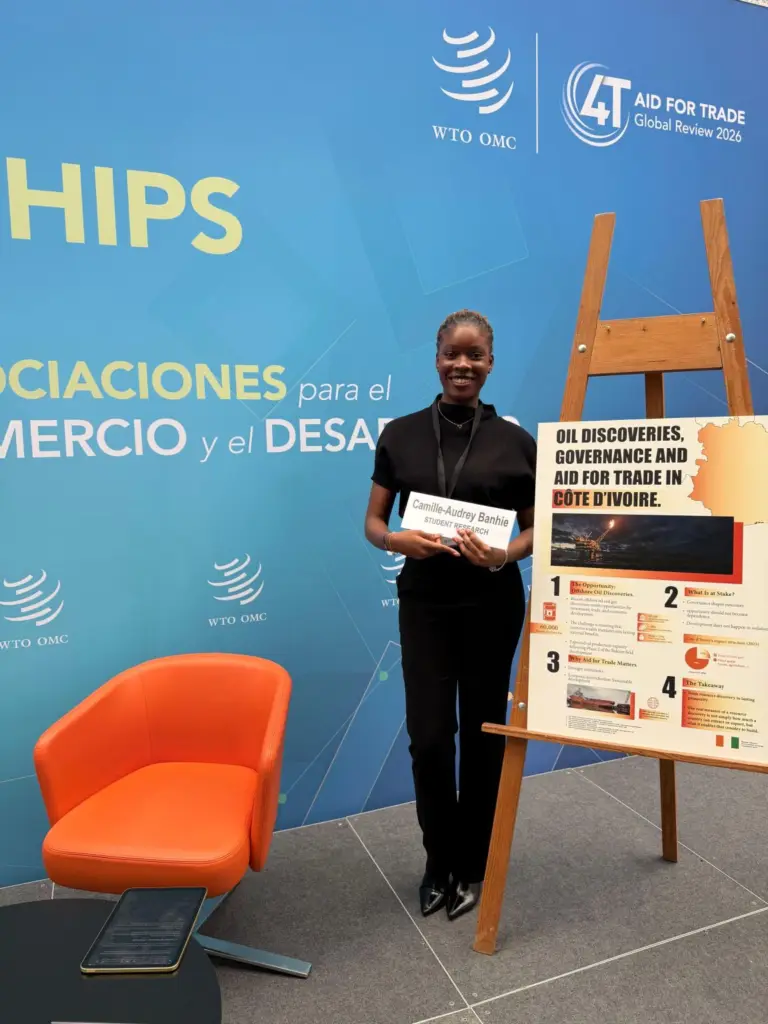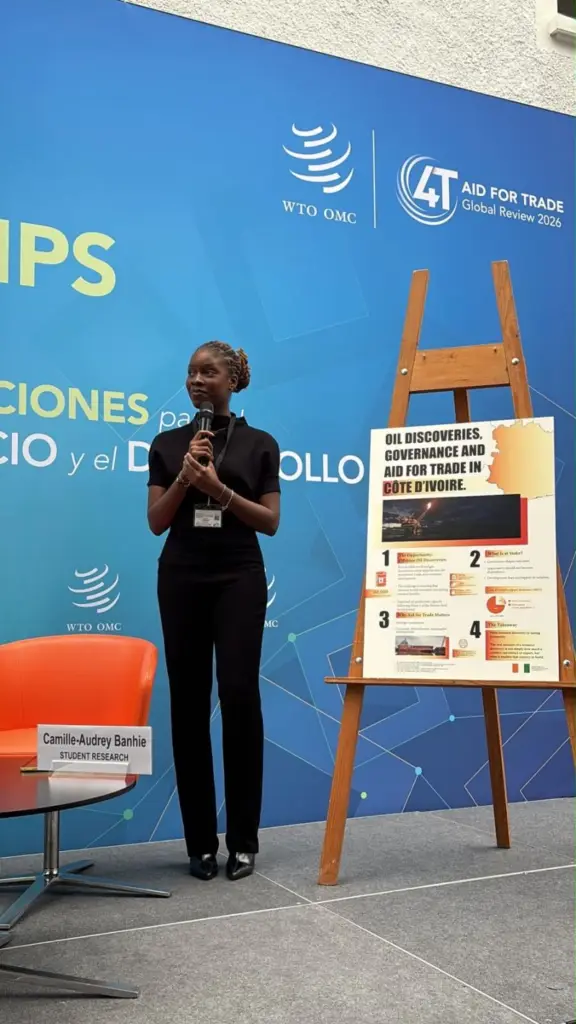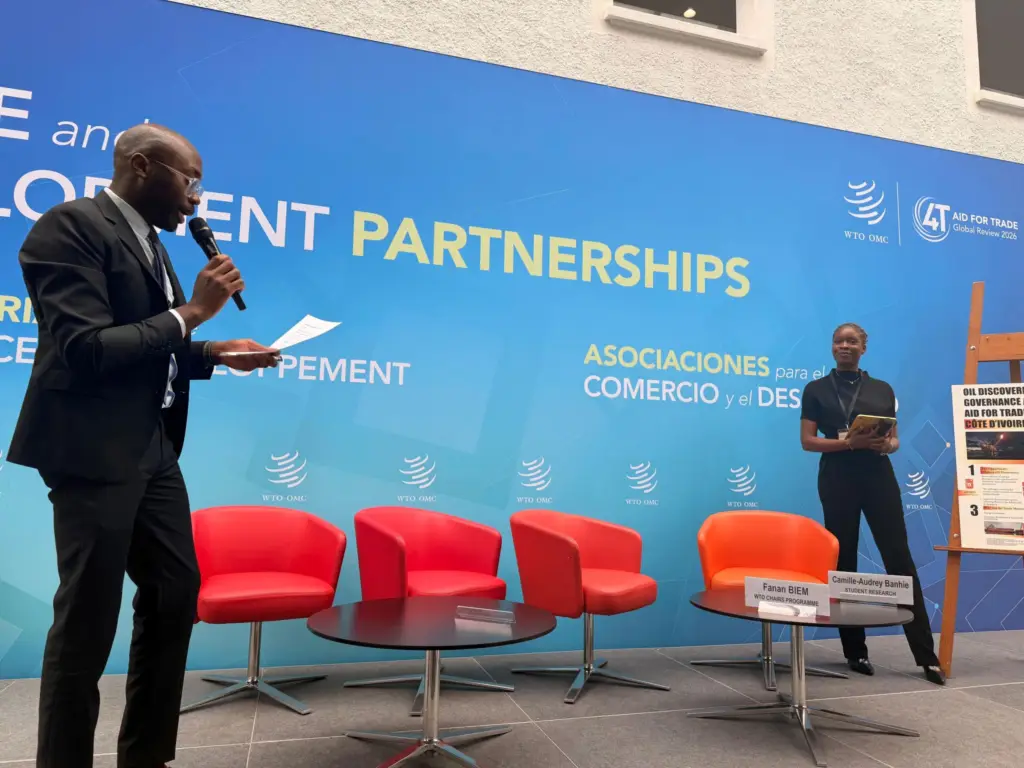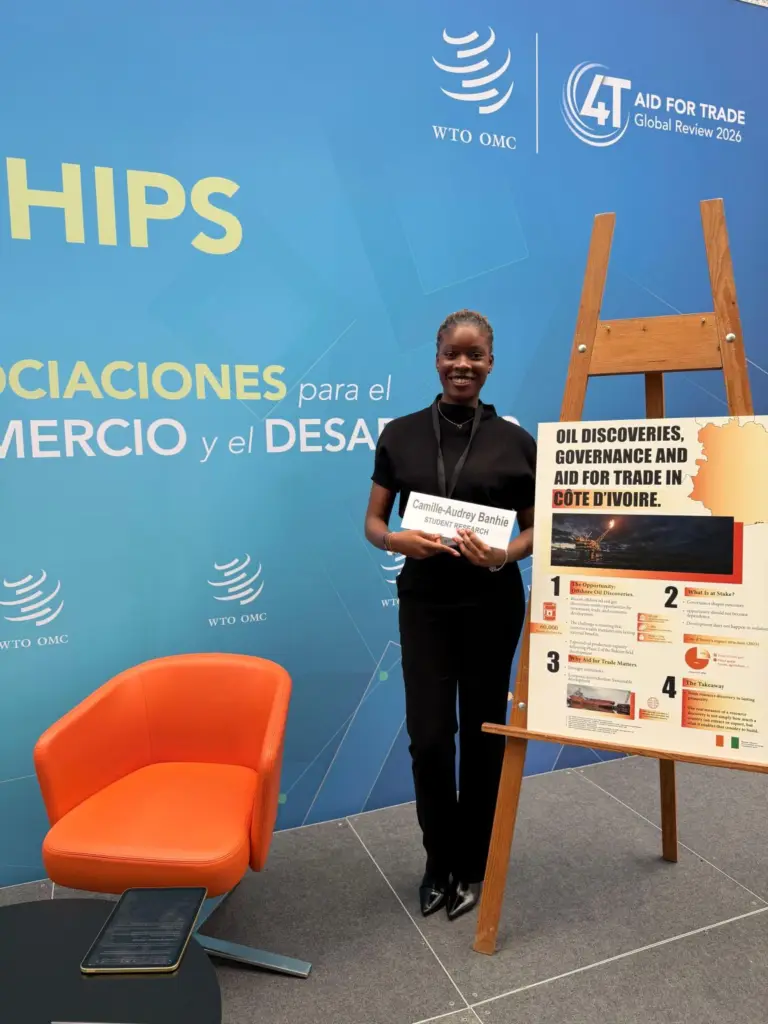
As a Master of International Relations student specialising in Trade at the Geneva School of Diplomacy (GSD), I had the opportunity to represent the School at the World Trade Organization (WTO) during the Global Review of Aid for Trade, as part of the Student Research Spotlight.
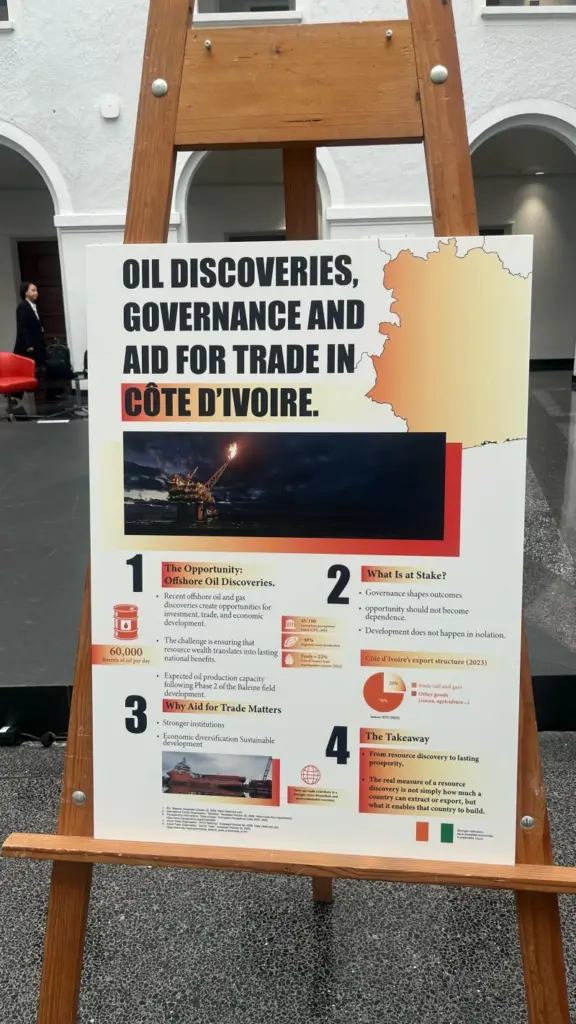
I presented my research, “Oil Discoveries, Governance and Aid for Trade in Côte d’Ivoire,” exploring the relationship between emerging oil production, resource governance, economic diversification, and the role of international trade in supporting sustainable development.
From natural resource discoveries to economic opportunities
Côte d’Ivoire’s recent offshore oil and gas discoveries, particularly the Baleine field, represent an important development in the country’s economic prospects. With production expected to reach approximately 60,000 barrels of oil per day following its second development phase, these discoveries create opportunities for investment, exports, and economic growth.
However, my research focuses on a question that goes beyond production figures: what determines whether natural resource discoveries translate into lasting economic development?
One of the central arguments of my research is that natural resources alone do not guarantee prosperity. Governance plays a fundamental role in determining how these resources are managed and how their economic benefits are distributed. Transparency, accountability, effective regulation, and responsible revenue management are essential to ensuring that resource wealth contributes to broader development objectives.
This is particularly relevant for Côte d’Ivoire, where emerging oil production must be considered alongside existing economic structures. The country is already a major player in international agricultural trade, accounting for approximately 40% of global cocoa production. Its challenge is therefore not simply to expand its natural resource exports, but to ensure that new oil and gas opportunities complement existing productive sectors and contribute to a more diversified economy.
Another important consideration is the role of foreign investment. International investors can bring capital, technology, and expertise, but countries also need the institutional capacity to negotiate effectively, regulate investment, and retain a meaningful share of the value generated by their resources.
The role of Aid for Trade
These considerations led me to examine the role of Aid for Trade in Côte d’Ivoire’s development prospects.
Aid for Trade is designed to help developing countries build the capacity to participate more effectively in international trade. In the context of Côte d’Ivoire, I believe this discussion is particularly important because the country’s development ambitions extend beyond increasing exports.
Three priorities stand out.
First, strengthening institutional and regulatory capacity is essential. Countries need effective institutions capable of managing investment, enforcing regulations, and ensuring transparency in economic activities.
Second, economic diversification must remain a priority. Emerging oil and gas production should create opportunities for other productive sectors rather than reinforce dependence on a limited number of commodities. Strengthening domestic production, developing value chains, and increasing the capacity to process and export higher-value products are important parts of this process.
Third, trade and development strategies must account for environmental sustainability. As the global economy moves towards a lower-carbon future, countries developing new fossil fuel resources must also consider long-term energy transitions and the risks associated with changing international markets.
Aid for Trade cannot address every structural challenge, but it can contribute to building the foundations that allow countries to turn international trade opportunities into broader development gains.
From the classroom to the multilateral stage
Presenting this research at the WTO was particularly meaningful because it allowed me to take an academic subject I had been exploring through my studies and bring it into a real multilateral setting.
It was an opportunity to share my findings, communicate my arguments, and engage with questions surrounding trade, development, and economic governance. It also gave me a different perspective on the relationship between academic research and international policymaking.
Studying International Relations with a specialisation in Trade has reinforced my interest in understanding how international economic systems operate, how countries negotiate their positions, and how multilateral institutions contribute to shaping global economic relations. Presenting at the WTO brought these interests together in a particularly relevant way.
It also reinforced an important lesson: discussions about international trade should not be limited to trade volumes, market access, or export figures. They should also consider the institutional, economic, and social conditions that determine who benefits from trade and how those benefits contribute to long-term development.
I am grateful to the Geneva School of Diplomacy for the opportunity to represent the School and share my research at the WTO. It was an important experience in connecting my academic interests with the professional environment I hope to pursue: international trade, economic diplomacy, and multilateral cooperation.
Ultimately, the question I wanted to raise through my research remains relevant beyond Côte d’Ivoire: the success of a resource discovery should not be measured only by how much a country can extract or export, but by what it enables that country to build.