
Donald Trump’s assertion on Sunday, 6 September 2026, that “the moon is ours” is best read as more than a provocation. It reflects a broader shift in how states may frame lunar activity: from a primarily scientific endeavor to a domain where influence, standards, and strategic leverage matter as much as, or more than, exploration. This trend raises a governance question that is already practical, not theoretical: if lunar operations expand faster than institutions can coordinate, competition may harden into exclusionary practices or avoidable safety crises.
For Geneva, the moment is consequential. Geneva has long functioned as a neutral platform for multilateral bargaining, legal clarification, and confidence-building in domains where trust is incomplete. In today’s space policy environment, Geneva’s potential lies in converting aspiration into workable processes: aligning legal interpretations, standardizing operational coordination, and sustaining inclusive legitimacy across competing national and regional frameworks. The goal is not to eliminate competition, but to discipline it through rules-based cooperation.
1. The Moon’s Strategic Value: Beyond Prestige
Lunar activity is increasingly driven by strategic logic rather than prestige alone. Three elements explain why states treat lunar involvement as consequential.
Resources and Long-Horizon Industrial Power
The Moon’s resources—especially water ice and, in some conceptual frameworks, other materials that could support in-situ production—are widely discussed as enablers of sustained off-world operations. Even when commercial viability remains uncertain, the perceived prospect of resource-based autonomy changes bargaining behavior. In effect, states with credible extraction and processing plans may gain political leverage: they can argue for operational priority, negotiate partnerships from a stronger position, and shape expectations about what “normal” lunar activity should look like.
Operational Access in a Crowded Future
A sustained lunar presence can support communications, navigation, and observation functions. Infrastructure on or around the Moon can become a hub for future missions, with implications for space situational awareness and for how actors deconflict trajectories and schedules. As launch and landing volumes grow, the Moon may become a coordination challenge: congestion is not only an Earth-orbit problem.
Technology as Leverage and Standard-Setting Influence
Finally, lunar missions create technical maturity: systems for long-duration habitation, autonomous operations, and high-reliability landing. Capability development becomes governance leverage because technical standards—whether related to safety, interoperability, or data-sharing—often evolve into de facto rules. Whoever can operationalize norms first can better translate those norms into durable practice.
Lunar competition will not only be about who reaches the Moon; it will be about who shapes the technical and legal conditions under which lunar operations occur.
2. Contested Lunar Competition: Multipolar Rivalry and Institutional Friction
The contemporary lunar environment is multipolar. Rivalry is not simply between two states; it is mediated through alliances, regional groupings, and institutional narratives about legality and legitimacy.
U.S.-Led Artemis and the Risk of “Bloc-Based” Standards
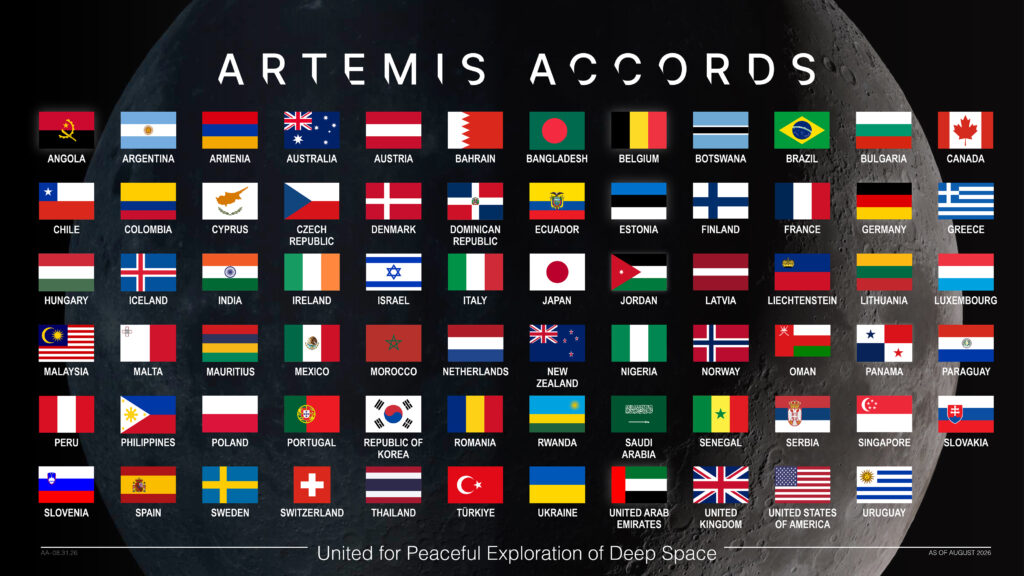
The U.S.-led Artemis Accords framework is presented as a means of promoting transparency, interoperability, and safety-oriented practices. For signatories, it offers a roadmap for aligning technical behaviors and sharing information. Yet governance risks emerge when concepts designed for coordination are interpreted as enduring entitlement structures.
A central example is the policy discussion surrounding “safety zones.” Even if intended as temporary deconfliction measures, any ambiguity about whether such zones imply long-term operational exclusion or quasi-jurisdiction can create resentment among non-signatories. Over time, ambiguous operational tools can harden into political expectations—precisely the pathway through which governance may become fragmented.
China’s ILRS and the Emphasis on Universality
China’s International Lunar Research Station (ILRS) concept emphasizes UN-centered cooperation and shared-benefit principles associated with the outer space legal order. This framing aims to protect universality, arguing that rule-making systems should not create divided spheres of influence in practice.
The governance problem is not that one side is “against cooperation.” It is that two different legitimacy models can coexist: one oriented around interoperability coalitions and the other around broad universality anchored in UN processes. Without bridging mechanisms, standards may diverge faster than missions can adjust.
Secondary Actors and Rising Operational Density
Other major actors—including EU member states, Japan, India, and emerging space partners—often pursue pragmatic strategies, maintaining scientific collaboration while expanding operational capability. However, the combined effect is a growing number of missions and a higher probability of scheduling and safety friction. When transparency and shared interpretive frameworks lag behind operational intensity, mistrust grows.
Legal Ambiguity Becomes Strategic Space
Even where states reaffirm peaceful purposes, lunar governance remains vulnerable because key concepts are not always operationalized consistently. In particular, the following questions can become interpretive fault lines: how “peaceful use” in the Outer Space Treaty should be interpreted in a domain with dual-use technologies; how resource activities relate to non-appropriation; and how “priority” should be understood relative to exclusivity. In such settings, uncertainty itself becomes leverage: ambiguous rules can be invoked to justify either restraint or competitive advantage.

3. Turning Rivalry into Governance: Three Coordinated Tracks
Preventing lunar governance failure requires action on three linked tracks: legal clarification, operational coordination, and inclusive multilateral rule-making. None can succeed in isolation.
Track 1: Clarify Meaning Before Norms Harden
States should converge on practical interpretations of existing space law principles—particularly around “peaceful use,” non-appropriation, and distinctions between priority and exclusivity. The objective is not to rewrite treaties, but to reduce the scope for opportunistic legal interpretation in operational settings.
When legal ambiguity persists, operational practice may outpace law, and subsequent negotiations become political rather than principled. Clarification should therefore precede the hardening of technical standards ecosystems.
Track 2: Operational Coordination Mechanisms That Build Trust
Governance is also practical. As missions multiply, the biggest risks are often not deliberate hostility, but interaction failures: landing congestion, trajectory interference, insufficient hazard data, or unclear emergency procedures.
Coordination can include:
- Shared hazard and mapping frameworks to reduce landing risks;
- Interoperability expectations for key communications and navigation functions;
- Common data-sharing practices, including incident reporting; and
- Contingency and emergency communication protocols for overlapping operations.
These tools function as confidence-building measures: they reduce both physical risk and the interpretive risk that one actor’s actions will be mistaken for another’s intent.
Track 3: Geneva as an Inclusive Convening and Norm-Shaping Center
Geneva’s comparative advantage is the legitimacy of its processes. It can convene actors who may not trust each other, yet still require practical coordination. Its strength is not to “pick a winner,” but to translate competing legal and technical narratives into shared working arrangements.
More specifically, Geneva can support:
- Cross-framework expert dialogues, including Artemis-aligned and UN-centered proponents;
- Drafting support for interpretive guidance and operational guidelines; and
- Institutional experimentation with confidence-building mechanisms—such as incident-reporting pilots and compatibility frameworks—that can later inform broader multilateral negotiations.
4. Conclusion: Why Multilateral Leadership Matters Now
The idea that “the moon is ours” signals a shift from exploration to influence. When influence becomes the organizing principle, lunar governance faces two dangers: fragmentation into competing rule systems that undermine interoperability and safety, and escalation stemming from uncertainty and misinterpretation rather than declared hostility.
The response should be equally practical and principled. Legal clarification can narrow interpretive uncertainty. Operational coordination can reduce real-world friction. Inclusive multilateral processes—anchored by Geneva’s convening capacity—can preserve legitimacy across different frameworks and prevent the bloc-driven normalization of ambiguous operational tools.
The Moon may belong to no single power, but the rules governing how it is used will be written through standards, practices, and negotiations. Geneva’s role should be to ensure that those rules are shaped through cooperative legitimacy rather than power rivalry.
Disclaimer
The views expressed in this article are those of the authors and do not necessarily reflect the institutional position of GSD.